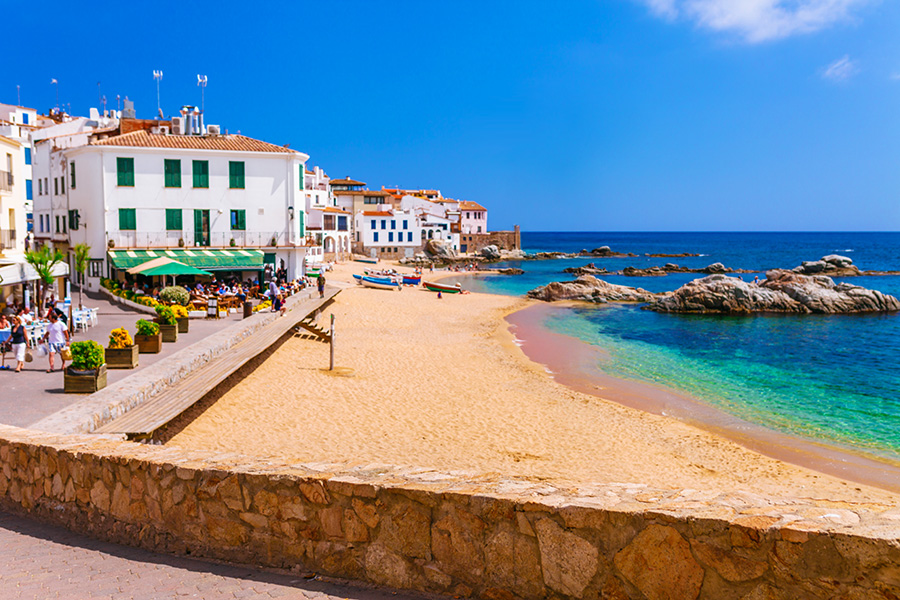
The Spanish housing market remains remarkably strong in the final quarter of 2025. For years, Spain has been a magnet for international buyers, mainly due to its unique combination of climate, lifestyle and high-quality real estate. But the market is also showing clear signs of acceleration in terms of figures. We take a closer look at it, in the Analysis Real Estate market Q4 2025 and look ahead to 2026.
General situation real estate market Spain in 2025 Q4
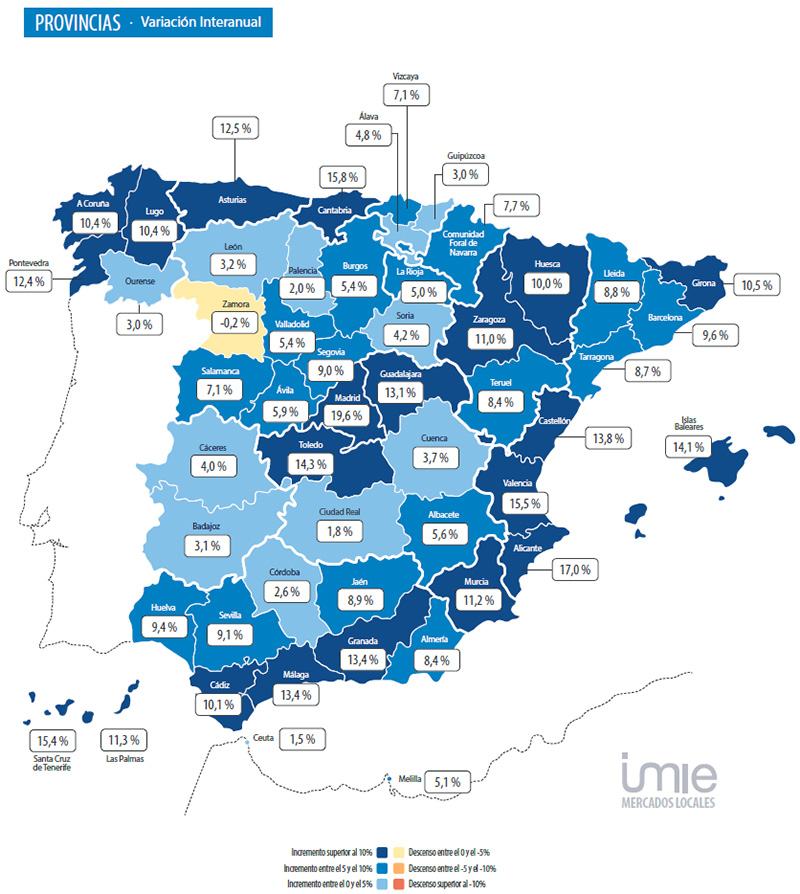
The market is in a healthy growth phase, with demand rising faster than supply can keep up. This is a crucial factor in understanding the current price pressure. Employment proved resilient in 2025, inflation stabilised, and interest rate cuts by the European Central Bank in the first half of 2025 contributed to more favourable credit conditions and lower mortgage costs.
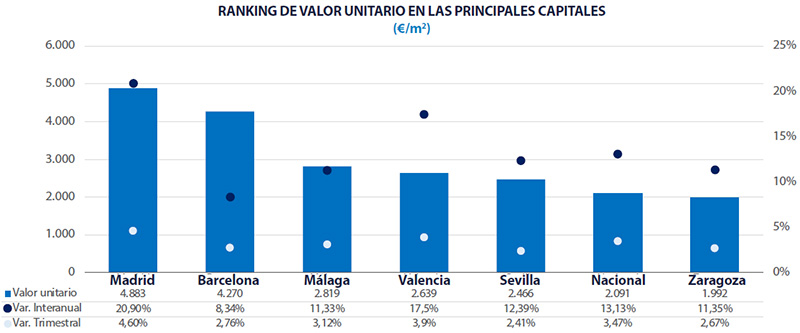
In Q4 2025, the average price of a finished home (new and existing) in Spain rose by +13.1% year-on-year and +3.5% compared to Q3 2025. Adjusted for inflation, this even means real growth of +10.0%, a particularly strong signal that the market is not only maintaining its upward trend, but is intensifying it. This growth is broadly supported by almost the entire country, but is most pronounced in regions with high employment and popular coastal tourist areas. The average price of new and existing homes in Spain was €2,091/m2.
Through October 2025, the number of home sales rose by +6.2% according to notaries and +14.4% according to the INE, with a total volume of around 550,000 transactions. The number of new mortgages taken out also rose sharply: +15.1% (notaries) and +33.4% (INE, excluding refinancing).
In short, Spain remains a market where demand is high, financing conditions are improving, but supply remains structurally scarce. This is precisely the basis for the current price acceleration.
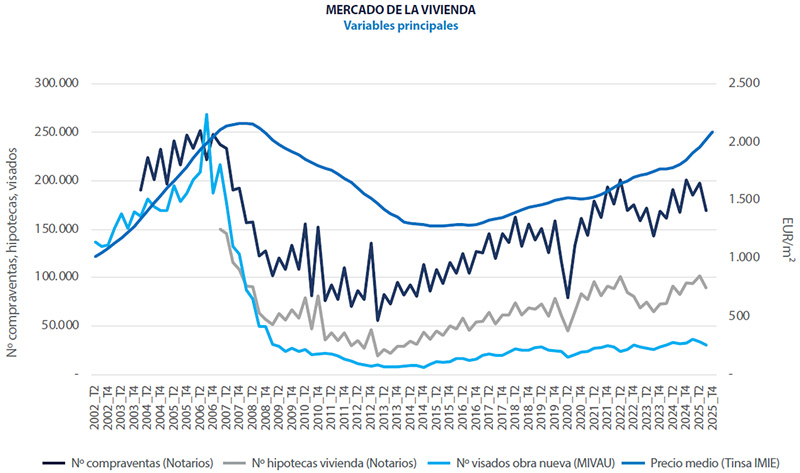
Property prices in Spain by autonomous region
The differences between the autonomous regions remain clearly visible in Q4 2025, but what is particularly striking is that all 17 regions are recording positive year-on-year growth. Madrid once again stands out as the absolute frontrunner. With a year-on-year increase of +19.6% in 2025 up to and including Q4, the capital region remains the highest segment in the country.
The Balearic Islands follow with a strong +14.1% year-on-year and quarterly growth of +3.6%, a logical consequence of the enormous international demand for luxury second homes and villas on islands such as Mallorca and Ibiza.
But the east coast also remains particularly strong. The Comunidad Valenciana showed a year-on-year increase of +15.9% in Q4, while the average price per square metre in this autonomous region now stands at €1,703/m². In Andalusia, prices rose by +9.6% year-on-year and +1.7% in Q4 2025, with an average price level of €1,781/m².
We see two distinct segments: on the one hand, the premium, urban core markets such as Madrid and Barcelona, where demand and prices are highest. On the other hand, the coastal areas and islands offer a wide and diverse range of properties, appealing to a variety of budgets and housing preferences. These regions continue to offer the greatest opportunities, especially for buyers looking for value growth and a Mediterranean lifestyle.
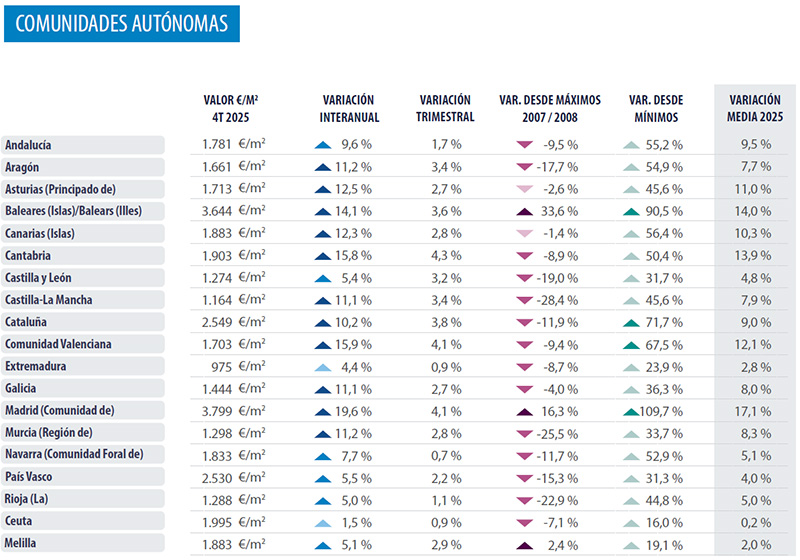
Property prices in Spain by province
On the Costa Blanca North (province of Alicante), prices rose by +17.0% year-on-year and +3.6% compared to Q3 2025, with a provincial average of €1,858/m².
In the province of Valencia, with the city of Valencia as its core market, the provincial average price is €1,735/m², after an annual increase of +15.5% and quarterly growth of +4.5%.
On the Costa Cálida (province of Murcia), the picture is slightly more moderate, but still growing: in Q4 2025, the province recorded an average of €1,298/m², with year-on-year growth exceeding national inflation.
The Costa del Sol, with Málaga as its core province, remains hugely popular with buyers. Prices continue to rise due to sustained international demand. In Q4 2025, the average was €2,697/m², +13.4% year-on-year and over 3% quarterly growth. A sought-after, stable and promising market for those looking to buy in Spain.
In the northern Mediterranean axis (Costa Brava, province of Girona), we are also seeing sustained year-on-year growth, with a provincial average of €2,058/m² and increases that exceed national inflation.
And then there are the island groups. In Santa Cruz de Tenerife (Canary Islands), prices rose to €2,034/m² (+15.4% year-on-year, +2.5% quarter-on-quarter). In Las Palmas (Canary Islands), the average is €1,851/m², also with a solid year-on-year increase.
It is also striking that several coastal provinces, including Alicante, Málaga and the Balearic Islands, are nominally closer to or above previous historical peak levels in Q4 2025, although in real terms they remain below 2007 values. This confirms that the market is structurally stronger and more broadly supported than in previous cycles.
Real Estate Prices in the Major Cities of Spain
In Q4 2025, Madrid remains the most expensive city in Spain, with a city-wide average of €4,883 per m². This represents an increase of +20.9% compared to a year earlier, and a further acceleration of +4.6% compared to the previous quarter (Q3 2025). Madrid thus remains a strong and sought-after segment where both the domestic and international markets are active. This is an important benchmark for understanding the strength of the Spanish housing market.
Barcelona also remains a stable, popular and internationally supported housing market, with an average price of €4,270 per m² in Q4 2025. The city recorded year-on-year growth of +8.3% and a quarterly increase of +2.8%. While Madrid and Barcelona are the premium urban reference markets, the real lifestyle and investment opportunities continue to be found mainly along the Spanish coasts and island groups.
In Valencia city, we see an average square metre price of €2,639/m² in Q4 2025, after an annual increase of +17.5%. With a 5-year CAGR of 10.9%, Valencia remains the strongest return city in the country.
On the southern Mediterranean coast (Málaga city), we see an average of €2,819/m² (+11.3% year-on-year) and a compound 5-year return (CAGR 9.4%).
Conclusion Spanish real market in 2025 and outlook for 2026
The fourth quarter of 2025 confirms that the Spanish housing market is ending the year in a strong growth phase. Prices continue to rise, demand remains high and supply is still limited in many popular regions. This means that 2025 has once again shown that investing in Spanish property has been a solid and attractive choice. The year offered plenty of opportunities for foreign buyers, especially those who were well prepared and dared to act at the right moment. This trend is expected to continue in the coming years.
In Valencia and on the Costa Blanca, Costa Brava, Costa Cálida, Costa del Sol, the Balearic Islands and the Canary Islands, we see that international interest remains strong. At the same time, Madrid and Barcelona remain important reference points: they show how quickly the market can move as soon as a good property becomes available.
Expectations for 2026
We expect this dynamic to continue in 2026. Demand will remain high, supply will remain tight and competition among buyers will remain fierce, particularly in the coastal and island markets. This means that anyone who wants to buy in 2026 would be wise to start early and, above all, to be ready to buy as soon as that one property comes along.
The best properties often sell quickly. That is why it is important that you, as a buyer, are ready to buy before you start viewing properties. In other words, your budget must be clear, your financing must be arranged or feasible, and your choices must be clear enough to be able to proceed immediately with the right property. In Spain, viewings are often not a non-committal “orientation round”, but the moment when you have to be able to make a decision.
In short: 2026 offers plenty of opportunities, but the best opportunities are for buyers who are prepared. Not because you have to make a hasty decision, but because in Spain you are simply rewarded if you are ready to act when the right property comes along.
Source: TINSA