The Spanish real estate market has got off to a strong start in 2026. In the first quarter, we are once again seeing clear price rises, widespread growth across the country and sustained strong demand from both domestic and international buyers. Whilst 2025 was already a strong year, Q1 2026 shows that this trend is not only continuing but is actually accelerating in many areas.
For buyers and investors, this means one thing: the Spanish property market remains in full swing, and opportunities lie primarily with those who are well prepared.
General situation real estate market Spain in 2026 Q1
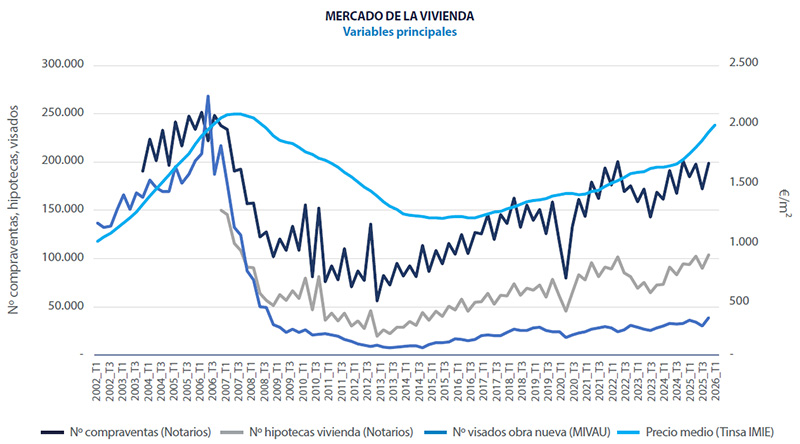
In the first quarter of 2026, house prices in Spain rose by +14.3% year-on-year and +3.2% quarter-on-quarter. Adjusted for inflation, this equates to real growth of +11.8%, confirming that the market is becoming structurally stronger.
The price rise is widespread and visible across virtually the whole of Spain, with the strongest growth around economic centres and tourist areas. At the same time, we are seeing the market begin to stabilise slightly in terms of activity: the number of transactions and mortgages shows slight declines compared to early 2025, but remains at a historically high level.
What is striking is that:
- demand remains high
- supply is lagging behind
- new-build supply is still insufficient to ease the pressure on the market
At the same time, external factors such as inflation and interest rates are once again playing a role. The rise in the Euribor towards 2.8% in March 2026 shows that financing is becoming slightly more expensive, but this has not yet put a significant brake on demand.
Property prices in Spain by autonomous region
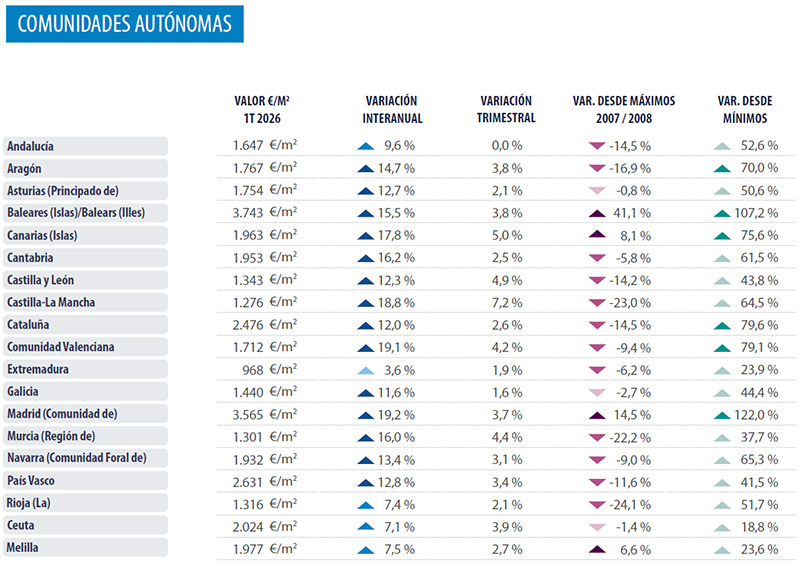
At regional level, we see that growth has broadened and deepened further in Q1 2026. Of the 19 autonomous regions, 14 are now recording year-on-year price rises of over 10%, confirming that the market is no longer driven solely by a few hotspots, but is becoming structurally stronger across the whole country.
Among the strongest performers are:
- Madrid: +19.2%
- Comunidad Valenciana: +19.1%
- Canary Islands: +17.8%
- Murcia: +16.0%
- Balearic Islands: +15.5%
What is striking is that it is precisely those regions combining economic dynamism with international appeal that are growing the strongest. Think of the Comunidad Valenciana, the region encompassing the popular Costa Blanca and, of course, Valencia city, and the archipelagos, where demand from foreign buyers is playing an increasingly significant role.
In addition, we see that many regions are now well above the price levels of a few years ago, with increases of more than 40% compared to the dip following the previous crisis. At the same time, most regions are still below the 2007 peak (adjusted for inflation), indicating that there is still room for further growth without the market becoming overheated.
Property prices in Spain by province
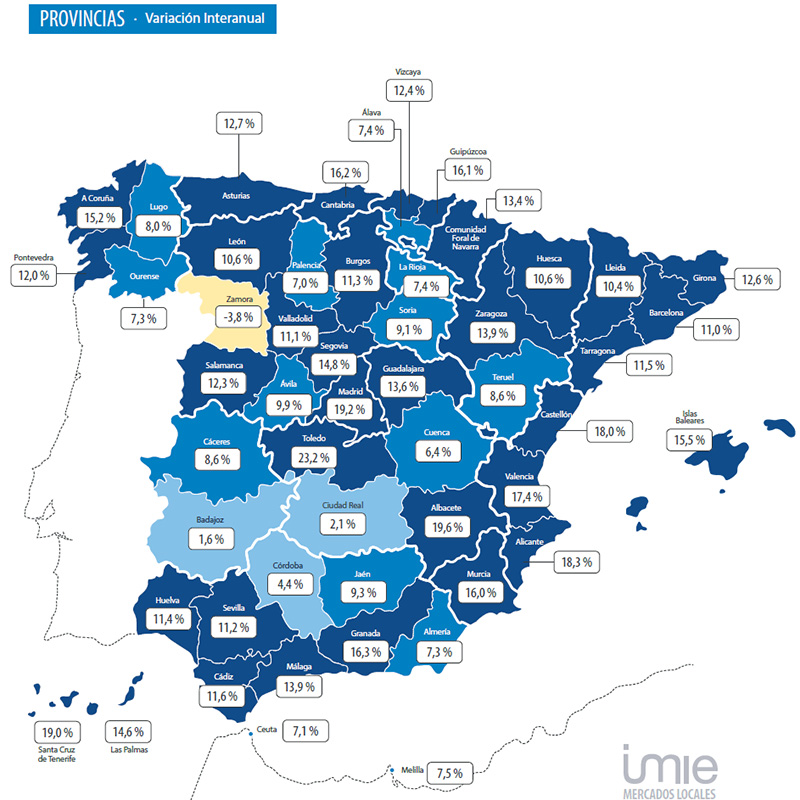
When we zoom in to the provincial level, the picture becomes even clearer. In no fewer than 34 of the 52 provinces, price rises exceed 10%, and in 40 provinces, growth is accelerating further compared with the previous quarter. This shows that price pressure is spreading further and further across the country.
The strongest increases are seen in, amongst others:
- Madrid: +19.2%
- Santa Cruz de Tenerife: +19.0%
- Alicante: +18.3%
- Castellón: +18.0%
- Valencia: 17.4%
Growth also remains robust in other coastal provinces and regions popular with foreign buyers. For instance, demand remains high in areas such as the Costa del Sol (Málaga) and the Murcia region, leading to sustained price pressure. At the top end of the market, the Balearic Islands in particular continue to record the highest price levels, averaging around €3,743/m².
What these figures show above all is that there are still significant price differences between provinces within Spain. This gives buyers a choice: do you opt for an established market, or for a region with further growth potential?
Real Estate Prices in the Major Cities of Spain
The major cities remain the beating heart of the Spanish housing market. This is where demand is highest, the market is most dynamic, and prices respond most quickly to market changes.
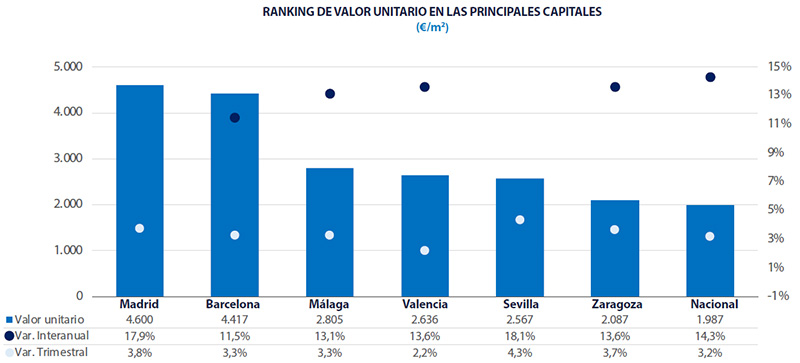
In Q1 2026, average prices stand at:
- Madrid: €4,600/m² (+17.9%)
- Barcelona: €4,417/m² (+11.5%)
- Málaga: €2,805/m² (+13.1%)
- Valencia: €2,636/m² (+13.6%)
- Seville: €2,567/m² (+18.1%)
What stands out here is that, in many cases, the major cities are growing faster than their surrounding provinces, although we also see that price levels are increasingly spreading to the surrounding region. This means that pressure on the housing market is not limited to the city itself, but is also being felt in suburban towns and surrounding areas.
In addition, cities such as Madrid and Barcelona continue to serve as key benchmarks: they demonstrate how far price trends can go in a market characterised by strong international demand and limited space. At the same time, Valencia is increasingly positioning itself as an alternative, offering an attractive combination of urban dynamism and a price level that remains relatively accessible.
For buyers, this means that cities continue to offer opportunities, but that speed and preparation are crucial, precisely because the best properties here often change hands quickly.
Conclusion Real Estate Market Spain 2026 Q1
The first quarter of 2026 confirms that the Spanish housing market is in a strong and mature growth phase. Price rises are widespread, demand remains high and supply remains limited – exactly the combination that characterised the market in 2025 as well.
For buyers, this means the market continues to move quickly, particularly in popular coastal regions and cities. Good properties are scarce and often sell quickly. That is why one piece of advice remains key: as a buyer, ensure you are ready to buy before you go to viewings. Those who are prepared can act immediately when the right property comes along.
Looking ahead to 2026, the market appears set to remain stable and strong, despite potential influences from interest rates and inflation. Spanish property therefore remains attractive not only for owner-occupation but also as a long-term investment.
In short: the Spanish property market continues to offer opportunities, but particularly for those who are well prepared and dare to make a decision at the right moment.
Would you like to know what this means specifically for your situation, or are you curious to find out which region best suits your needs? Please feel free to contact us. We’d be happy to help you explore your options.
Source: TINSA